

Uroplakin II – Increased Sensitivity in Urothelial Carcinoma
Bladder cancer is the seventh most commonly occurring cancer in the United States with 73,469
new cases reported in 2016 and is associated with high recurrence & progression rates.
Bladder cancer is the seventh most commonly occurring cancer in the United States with 73,469 new cases reported in 2016 and is associated
with high recurrence & progression rates1. About 70% of superficial bladder cancer patients will experience tumor recurrence and 10-15% of this
sub-population will eventually progress to muscle invasion2. Early diagnosis, when the disease is still at a localized stage, increases the chance of
successful treatment. The survival rate for in situ urinary bladder cancer is 97%3. Tissue-based biomarkers for early diagnosis of bladder cancer are
of major clinical need. Urothelial carcinoma (UC) of the bladder typically originates in the urothelium and accounts for more than 90% of all bladder
tumors. Biomarkers expressed in the urothelium, such as uroplakins (UP), could be predictive markers of UC of the bladder. Pathologists have used
UP III [AU1] to establish urothelial origin of the bladder; however, use of AU1 is limited due to its poor sensitivity.
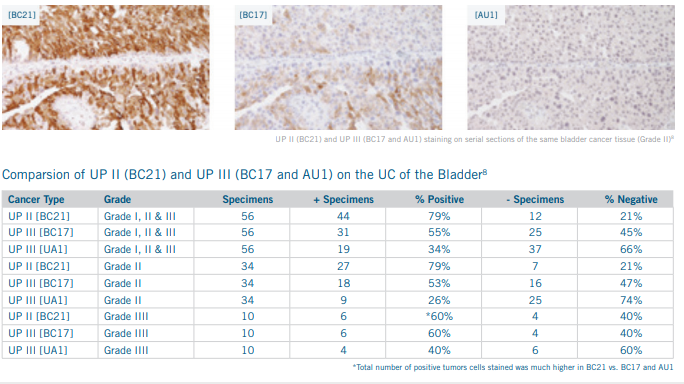
UPII [BC21] exhibited superior specificity, making it useful in the identification of tumors of urothelial origin.
Recent studies have shown a monoclonal mouse anti-UPII antibody [BC21] to demonstrate increased sensitivity in UC of the bladder when compared
to mouse monoclonal UPIII antibodies [BC17 and AU1]. UPII [BC21] exhibited superior specificity, thus making it useful in the identification of
tumors of urothelial origin. The highly sensitive and specific UP II [BC21] may serve as a promising tissue-based biomarker in the differential
diagnosis of UC and in the detection of tumor of unknown origin, specifically in cases of metastatic bladder cancer that has spread to the prostate.
The combination of GATA-3 (nuclear) and UPII (cytoplasmic/membrane) in a single color format increased both specificity and sensitivity in a
single section7,8. GATA-3 increases the overall specificity when compared to UPII alone and it does not stain prostate adenocarcinoma or renal
cell carcinoma4,5. Thus, two antigens, GATA-3 (nuclear) and UPII (cytoplasmic/membrane), can be recognized and discerned on the same section
by a single color. This cocktail has been formulated for manual and automated IHC on a variety of platforms.
To learn more about Uroplakin II [BC21] or the Uroplakin II + GATA-3 cocktail please contact Biocare Medical at 800-799-9499 or visit the
following links: https://biocare.net/product/uroplakin-ii-antibody/; https://biocare.net/product/gata-3-uroplakin-ii/.
1. Centers for Disease Control and Prevention. US Cancer Statistics: Data Visualizations 2016. 2. Frantzi M, Makridakis M, Vlahou A. Biomarkers for bladder cancer aggressiveness. Curr Opin Urol. 2012 Sep;22(5):390-6. 3. Jemal A, et al. Cancer statistics, 2010. CA Cancer J Clin. 2010 Sep-Oct;60(5):277-300. 4. L Hoang, et al. A newly developed uroplakin II antibody with increased sensitivity in urothelial carcinoma of the bladder. Arch Pathol Lab Med. 2014 Jul;138(7):943-9 5. Mohammed KH, Siddiqui MT, Cohen C. GATA3 immunohistochemical expression in invasive urothelial carcinoma. Urol Oncol. 2016 Oct;34(10):432. May 27. 6. Miyamoto H, Izumi K, Yao JL, Li Y, Yang Q, McMahon LA, Gonzalez- Roibon N, Hicks DG, Tacha D, Netto GJ. GATA binding protein 3 is down-regulated in bladder cancer yet strong expression is an independent predictor of poor prognosis in invasive tumor. Hum Pathol. 2012 Nov;43(11):2033-40. 7. Leivo MZ, Elson PJ, Tacha DE, Delahunt B, Hansel DE. A combination of p40, GATA-3 and uroplakin II shows utility in the diagnosis and prognosis of muscle-invasive urothelial carcinoma. Pathology. 2016 Oct;48(6):543-9. 8. Hoang LL, Tacha D, Bremer RE, Haas TS, Cheng L. Uroplakin II (UPII), GATA3, and p40 are Highly Sensitive Markers for the Differential Diagnosis of Invasive Urothelial Carcinoma. Appl Immunohistochem Mol Morphol. 2015 Nov-Dec;23(10):711-6.