Breast cancer stained with GLUT-1 antibody

GLUT-1

Glucose transporter 1, also known as GLUT-1 antibody or SLC2A1 is a protein in humans encoded by the SLC2A1 gene. GLUT-1 antibody facilitates the transport of glucose across the plasma membranes of mammalian cells. GLUT1 is responsible for the low-level of basal glucose uptake required to sustain respiration in all cells. Several glucose transporter protein […]

Breast cancer stained with GATA-3 antibody

GATA-3

GATA-3 (GATA binding protein 3) is a member of the GATA family of transcription factors. This 50 kDa nuclear protein regulates the development and is expressed in specific cell types within a variety of tissues.1,2 GATA-3 is a zinc finger transcription factor and plays an important role in promoting and directing cell proliferation, development, and […]

Lung adenocarcinoma from L to R: 2+ staining, 3+ staining with Folate Receptor alpha antibody

Folate Receptor alpha IHC Assay Kit

Mouse anti-human folate receptor alpha antibody monoclonal [26B3.F2] specifically recognizes the alpha isoform of folate receptor. Folate receptor alpha is primarily expressed in the apical surface of some polarized epithelial cells of normal tissues (such as kidney, lung, breast, and salivary glands) and on many cancer cells of epithelial origin; namely, ovarian cancer, thyroid cancer, […]

Dermatofibroma stained with Factor XIIIa Antibody

Factor XIIIa

This is a monoclonal antibody to the A-subunit of human coagulation Factor XIII. Studies have shown it recognizes human Factor XIII Achain in both reduced and non-reduced forms. It does not react with human Factor XIII B-chain or human Factor XII. Factor XIII is a betaglobulin found in plasma and is composed of two subunits. […]

Breast cancer stained with Estrogen-Receptor-ER-Antibody [6F11 + SP1]

Estrogen Receptor (ER) [6F11 + SP1]

Estrogen Receptor ER antibody clone 6F11 is a 66-kDa protein that mediates the actions of estrogens in estrogen-responsive tissues. The ER gene consists of more than 140kb of genomic DNA divided into 8 exons. These translate into a protein with six functionally discrete domains, labeled A through F. This mouse monoclonal antibody has been established […]

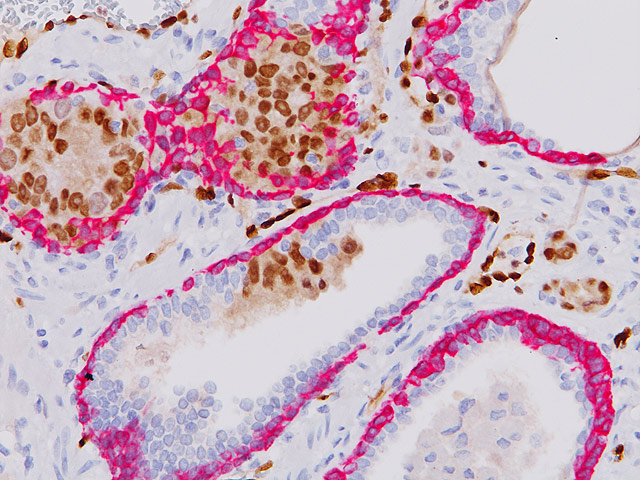
ERG (DAB) + CK5 (FR) in prostate cancer and PIN

ERG-2 (ERG + CK5)

Chromosomal translocations involving the ETS transcription factors, such as ERG and ETV1, are frequent events in human prostate cancer pathogenesis. In particular, the TMPRSS2-ERG fusion gene has recently been found to be the most frequent gene rearrangement in prostate cancers, occurring in 45-65% of North American patients. Recent reports have demonstrated a strong correlation between […]

Prostate cancer stained with ERG + AMACR antibody

ERG + AMACR

In human prostate cancer, the ERG oncogene is frequently overexpressed due to chromosomal translocations involving ERG and regulatory sequences of the TMPRSS2 or other androgen responsive genes. Recently, a mouse monoclonal anti-ERG antibody was developed with an unprecedented 99.9% specificity for detecting prostatic adenocarcinoma. The report shows strong correlation between the expression of the ERG […]

ERG translocation in prostate cancer

ERG (M), 2X

In human prostate cancer, the ERG oncogene is frequently overexpressed due to chromosomal translocations involving ERG and regulatory sequences of the TMPRSS2 or other androgen responsive genes. In particular, the TMPRSS2:ERG fusion gene has been found to be the most frequent gene rearrangement in prostate cancers, occurring in 45-65% of North American patients. A mouse […]

Prostate cancer stained with ERG antibody

ERG

In human prostate cancer, the ERG oncogene is frequently overexpressed due to chromosomal translocations involving ERG and regulatory sequences of the TMPRSS2 or other androgen responsive genes. In particular, the TMPRSS2:ERG fusion gene has recently been found to be the most frequent gene rearrangement in prostate cancers, occurring in 45- 65% of North American patients. […]

Email Cart