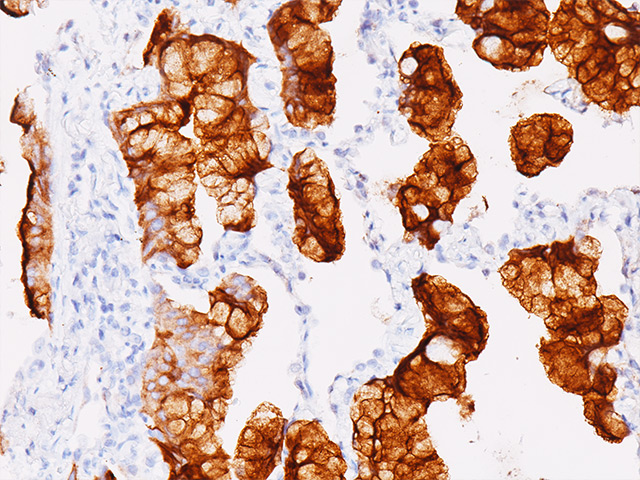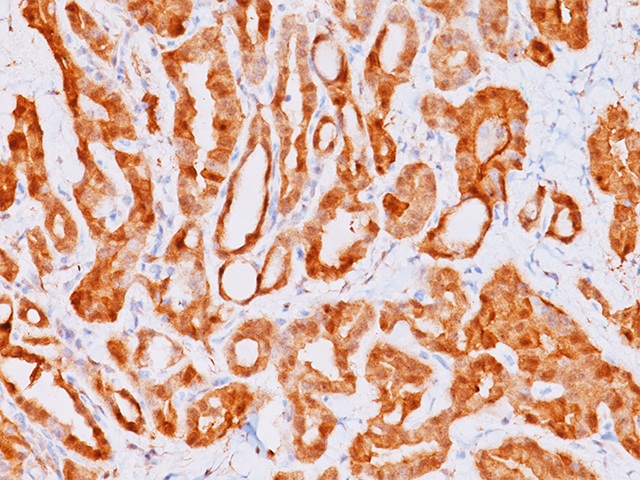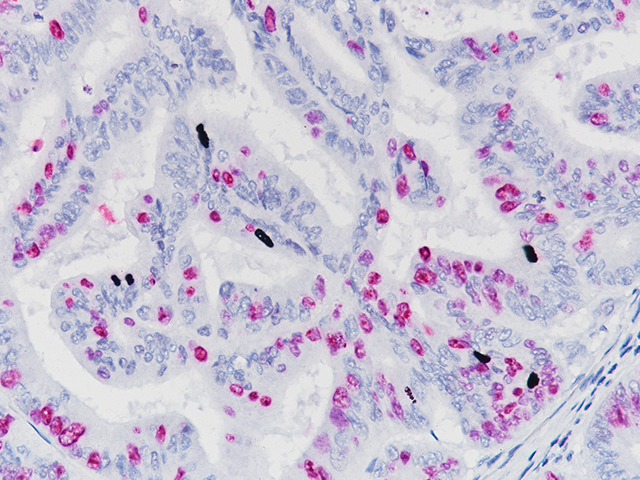
The Ki-67 nuclear antigen is associated with cell proliferation and found throughout the cell cycle; though not in G0 phase (1,2). The assessment of Ki-67 proliferation in breast cancers has shown the Ki-67 labelling index is an important predictor of survival (3). Microscopic evaluation of mitotic figures on H&E is a routine procedure in the […]
Gene rearrangement in t(14;18)/IGH-MALT1 was detected in MALT lymphoma first. The frequencies at which the translocation occurs vary markedly with the primary site of the disease1. IGH-MALT1 rearrangements were described also in other B-NHLs such as DLBCL (Diffuse Large B-Cell Lymphoma)2. IGH-MALT1 fusion in the t(14;18)(q32;q21) have been identified in marginal zone B-cell lymphomas of […]
CDX2 is a homeobox gene that encodes an intestine-specific transcription factor and is expressed in the nuclei of epithelial cells of the intestine, from duodenum to rectum. The CDX2 protein is expressed in primary and metastatic colorectal carcinomas (1,2). It has also been identified in primary ovarian mucinous tumors and metastatic mucinous carcinomas involving the […]
Immunoglobulin G (IgG) is an antibody isotype secreted by plasma cells and composed of four peptide chains – two identical heavy chains and two identical light chains arranged in a Y-shape typical of antibody monomers (1). In humans, IgG consists of four subclasses that differ only marginally in their amino acid composition (1). Representing approximately […]
Chromosome 6q deletions are also commonly found in lymphoid malignancies such as acute lymphocytic leukemia (ALL), approx 30% of cases1; chronic lymphocytic leukemia (CLL), non-Hodgkins lymphoma (NHL), approx 7%, multiple myeloma (MM), mantle zone lymphoma (MZL), and Waldenström’s macroglobulinemia (WM)2. FOR DISTRIBUTION OUTSIDE THE UNITED STATES ONLY
Amplication of the 1q21 locus has been demonstrated in hepatocellular carcinoma and represents one of the most frequently detected genomic alterations in that disease1. Further, the 1q21.3 region has also been reported to harbor a gene that has been shown to demonstrate a high level of expression in prostate cancer2. FOR DISTRIBUTION OUTSIDE THE UNITED […]
This probe has been used in conjunction with 1q21.3 as a copy enumeration probe1. Principle of Procedure: The 1p21.2 Probe is approximately 655 kb in size and is designed to provide coverage of the 1p21.2 region of chromosome 1. FOR DISTRIBUTION OUTSIDE THE UNITED STATES ONLY
Deletions of chromosome 6q are found in many types of cancer, including melanoma, prostate cancer, fibroadenomas, and carcinoma of breast and other sites1. Chromosome 6q deletions are also commonly found in lymphoid malignancies such as acute lymphocytic leukemia (ALL), approx 30% of cases2; chronic lymphocytic leukemia (CLL), non-Hodgkins lymphoma (NHL), approx 7%, multiple myeloma (MM), […]
Mesothelin is a cell surface glycoprotein that elicits T cell responses, first described as the antigenic target of the K1 monoclonal antibody, generated by using an ovarian cell line as immunogen (1,7). In normal tissues, mesothelin expression is largely restricted to mesothelial cells. However, immunoreactivity for this marker has also been reported in some epithelial […]
Galectin-3 shows strong diffuse cytoplasmic staining in most cases of papillary thyroid carcinoma (PTC), including the classical and follicular variant (1). Follicular carcinomas with minimal and extensive invasion may also express galectin-3 (2). Most poorly differentiated thyroid cancers demonstrate galectin-3 protein expression while it is not expressed in anaplastic thyroid cancers (3,4). Medullary thyroid carcinomas […]