CMV is a member of the human herpes virus-5, HHV-5 group and can be transmitted via breast milk, during organ transplantation, sexual activity or blood transfusions. It is estimated that 40-100% of people may be infected with this virus (1,2,4). CMV infections are common causes of morbidity and mortality especially in immune compromised individuals (1-3). […]
Immunoglobulin lambda light chain mRNA may be detected in normal and neoplastic B-cells in human lymphoid tissue (1-3). Lambda Light Chain Probe is a digoxigenin-conjugated DNA oligonucleotide designed to bind human lambda light chain mRNA.
Uroplakin II is a 15 kDa protein component of urothelial plaques, which enhance the permeability barrier of the urothelium. 15 Uroplakin II [BC21] is a highly specific antibody that may be useful in identifying tumors of urothelial origin.
Tyrosinase is a key enzyme involved in the initial stages of melanin biosynthesis. Studies have shown Tyrosinase antibody to be a more sensitive marker for melanoma when compared to HMB45 and MART-1. It has also shown to label a higher percentage of desmoplastic melanomas than HMB45. Unlike HMB45, Tyrosinase does not discriminate between activated or […]
Topoisomerase II alpha (Topo IIa) plays an important role in DNA synthesis and RNA transcription, as well as chromosomal segregation during mitosis. It is reported to be a sensitive and specific marker of late S-, G2- & M-phases in transformed and developmentally regulated normal cells. Topo IIa is also implicated in drug resistance of tumor […]
SALL4, a zinc-finger transcriptional factor, is required for the maintenance of embryonic stem cell pluripotency by modulating Oct4 and is mapped to chromosome 20q13.15,16 SALL4 is a novel sensitive and specific marker for seminomas and ovarian primitive germ-cell tumors. Studies demonstrate that most tumor cells in intratubular germ cell neoplasias and embryonal carcinomas show strong […]
In normal epithelia, HMW Cytokeratins (CK5 and CK14) stain basal epithelia in the prostate gland.p63 is detected in prostate basal epithelial nuclei in normal prostate, however, is negative in malignant tumors of the prostate gland. Thus p63 is useful as a differential marker for benign and malignant tumors of the prostate gland and can be […]
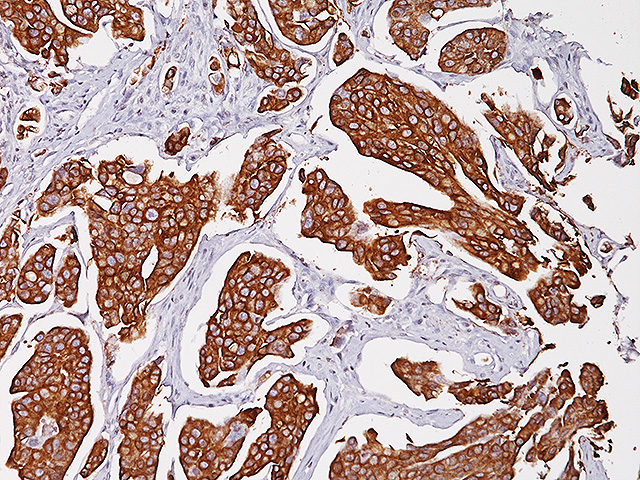
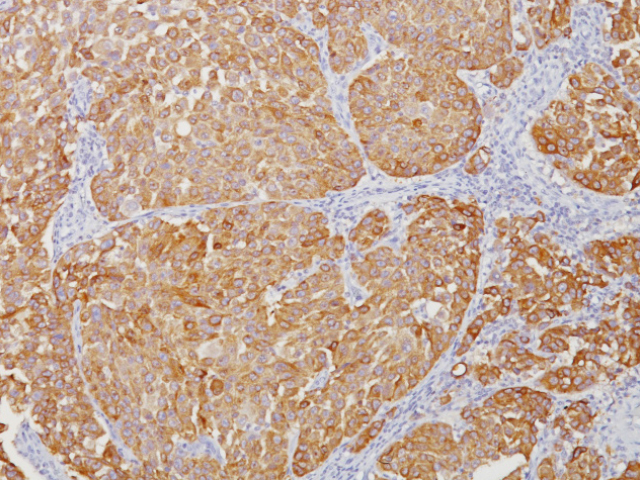
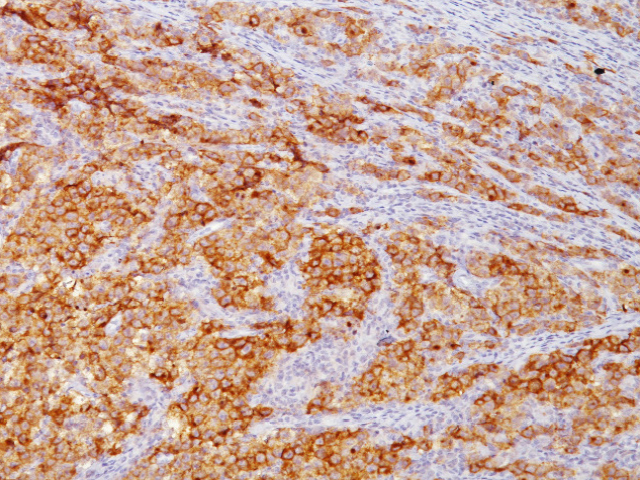
The progesterone receptor is a member of the steroid-receptor family. Steroid hormones bind to intracellular receptors, and these receptors can bind to DNA and regulate gene expression directly. Research has shown PR to reflect intact estrogen regulatory machinery.
PGR clone 16 is directed against the human progesterone receptor molecule.5-9 PGR clone 16 reacts with both A and B forms of human progesterone receptor by Western blotting procedure.8
Placental Alkaline Phosphatase (PLAP) reacts with a membrane-bound isozyme (Regan and Nagao type) of PLAP occurring in the placenta during the 3rd trimester of gestation. This antibody is highly specific to PLAP and shows no cross-reaction with other isozymes of alkaline phosphatases. It is useful in the identification of testicular germ cell tumors and in […]


![Breast cancer stained with Progesterone Receptor [PgR636] antibody](https://biocare.net/wp-content/uploads/sw.jpg)
![Breast cancer stained with Progesterone Receptor antibody (PR) [16]](https://biocare.net/wp-content/uploads/sl.jpg)