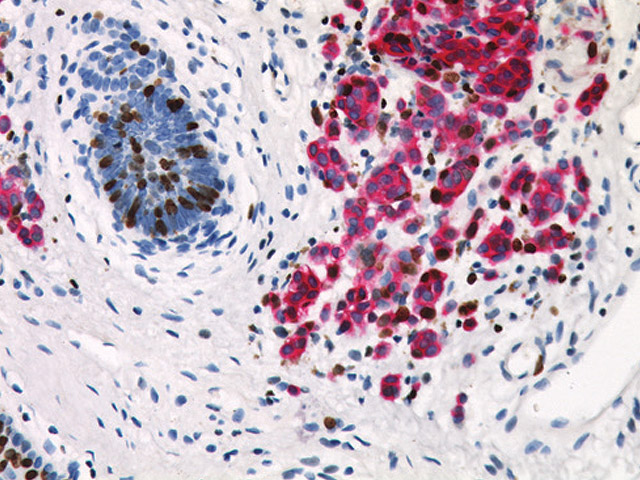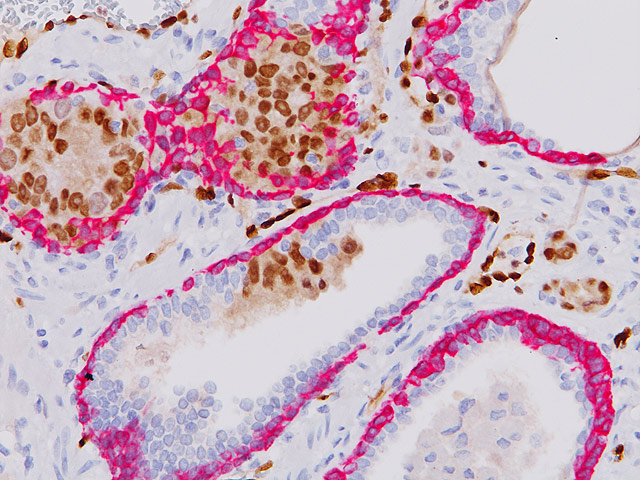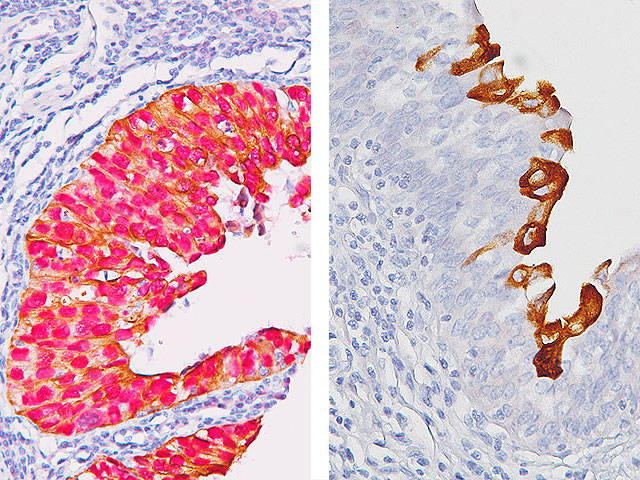
(L) Bladder CIS & (R) Reactive atypia in bladder stained with Uro-2™

Uro-2 (CK20 + p53)

Uro-2 (CK20 + p53) is a primary antibody cocktail for the multiplex IHC identification of CK20 and p53 proteins in bladder. Studies have shown that in normal urothelium, the superficial umbrella cell layer shows reactivity for CK20 only; whereas, p53 nuclear staining is absent to focal. For urothelium with reactive atypia, particularly in cases with […]

Melanoma stained with Pan Melanoma + S100 antibody

Pan Melanoma + S100

Pan Melanoma Antibody +S100 (Tyrosinase) is a key enzyme involved in the initial stages of melanin biosynthesis. Studies have shown Tyrosinase to be a more sensitive marker when compared to HMB45 and MART-1. It has also shown to label a higher percentage of desmoplastic melanomas than HMB45. MART-1 (M2-7C10 + M2-9E3) recognizes a protein of […]

Melanoma stained with Pan Melanoma (FR) + Ki-67 (DAB) cocktail Antibody

Pan Melanoma + Ki-67

Pan Melanoma Antibody + Ki-67 serves as a tool to identify the proliferation rate of melanocytic lesions in cases in which melanocytes are sparse; there are dense lymphocytic infiltrates; and melanocytes are admixed with fibroblasts. In general, a higher proliferative fraction is seen in melanoma than in melanocytic nevi. There are many types of nevi, […]

Breast cancer stained with p63 antibody

p63, 3X (Breast)

p63, 3X (Breast) is being discontinued. We will continue to offer these products until 06/30/16 or until current inventory is depleted, whichever occurs first. Biocare does offer p63, catalog numbers CM163, PM163, IP163, VP163, OAI163 as a substitute. p63, 3X (Breast) [4A4] is comprised of a mouse monoclonal anti-p63 antibody. p63 is a transcription factor […]

Prostate tissue stained with p63 antibody

p63

p63, a homolog of the tumor suppressor p53, has been identified in basal cells in the epithelial layers of a variety of tissues, including epidermis, cervix, urothelium, breast and prostate.15 p63 was detected in nuclei of the basal epithelium in normal prostate glands; however, it was not expressed in malignant tumors of the prostate.16 As […]

Prostate cancer stained with P504S antibody, 2X

P504S-2X

P504S, also known as α-methylacyl coenzyme A racemase (AMACR), is a peroxisomal and mitochondrial enzyme that has been shown to play a role in bile acid synthesis and β-oxidation of branched chain fatty acids. In immunohistochemistry studies, P504S has been shown to be a specific marker of prostatic adenocarcinoma. Additionally, prostate glands involved in PIN […]

Smooth muscle stained with Muscle Specific Actin antibody (MSA)

Muscle Specific Actin

The Muscle Specific Actin antibody [HHF35] recognizes muscle specific alpha and gamma actin isomers. It does not react with non-muscle actin. Studies have shown that it recognizes the alpha actin from cardiac, skeletal and smooth muscle sources. It does not react with beta or non-smooth muscle gamma actin isomers. The antibody labels leiomyoma, leiomyosarcoma, angiomyolipoma […]

Melanoma stained with HMB45 + MART-1 + Tyrosinase Antibody

HMB45 + MART-1 + Tyrosinase

The HMB45 clone reacts with a neuraminidase-sensitive oligosaccharide side chain of a glycoconjugate present in immature melanosomes. Studies have shown the HMB45-reactive antigen is present in cutaneous melanocytes, prenatal and infantile retinal pigment epithelium and melanoma cells. It is also thought to be oncofetal in nature.15 The MART-1/Melan A recognizes a protein of 18kDa, identified […]

ERG (DAB) + CK5 (FR) in prostate cancer and PIN

ERG-2 (ERG + CK5)

Chromosomal translocations involving the ETS transcription factors, such as ERG and ETV1, are frequent events in human prostate cancer pathogenesis. In particular, the TMPRSS2-ERG fusion gene has recently been found to be the most frequent gene rearrangement in prostate cancers, occurring in 45-65% of North American patients. Recent reports have demonstrated a strong correlation between […]

Email Cart