PRAME is located on chromosome 22q11.22 and encodes a 509 amino acid protein. PRAME is an autosomal cancer-testis antigen (CTA) gene which has been shown to be expressed in melanoma, various nonmelanocytic malignant neoplasms, including non-small cell lung cancer, breast carcinoma, renal cell carcinoma, ovarian carcinoma, leukemia, synovial sarcoma, and myxoid liposarcoma. Normal healthy tissues […]
p16 INK4a is a tumor suppressor protein involved in the pathogenesis of a variety of malignancies and is a 16.5 kDa protein expressed in the nucleoplasm of proliferating cells, functioning as an inhibitor of CDK4. Recent analyses of the p16INK4a gene revealed homozygous deletions, nonsense, missense, or frameshift mutations in several human cancers. p16 INK4a […]
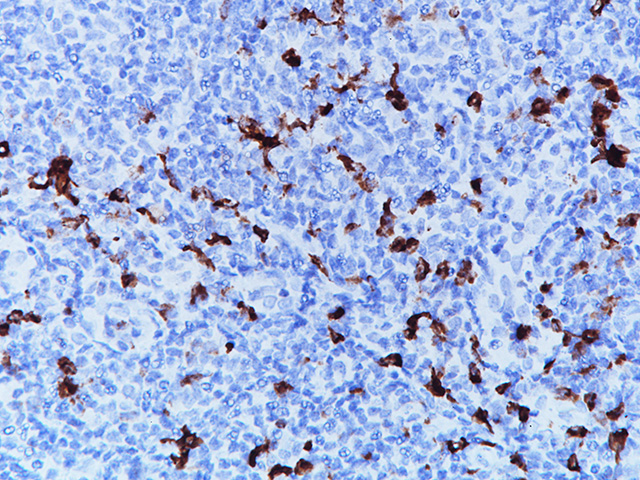
CD8 [C8/1779R] is a rabbit monoclonal antibody that is intended for laboratory use in the qualitative identification of CD8a protein by immunohistochemistry (IHC) in formalin-fixed paraffin-embedded (FFPE) human tissues. The clinical interpretation of any staining or its absence should be complemented by morphological studies using proper controls and should be evaluated within the context of […]
Cytotoxic T lymphocyte-associated antigen-4 (CTLA-4) is a member of the CD28 superfamily and is a negative regulator of T cell-mediated immune responses. CTLA-4 expression is induced on the surface of T cells after CD28 binding and activation, and is constitutively expressed on T-regulatory cells, acting as an immune checkpoint inhibitor, downregulating T cell activity. (1-3). […]
LAG-3 (Lymphocyte Activation Gene 3) is a surface receptor expressed on activated T cells, an exhaustion marker with immunosuppressive activity (1). Major histocompatibility complex class II (MHC-II) is a ligand for LAG-3; additional ligands (e.g., LSECtin and galectin-3) have also been identified (1,2). Regulatory T cells (Tregs) expressing LAG-3 have enhanced suppressive activity, whereas cytotoxic […]
CD22 [BLCAM/1796] is a type 1 integral membrane glycoprotein with molecular weight of 130 to 140 kDa. It is expressed in both the cytoplasm and cell membrane of B-lymphocytes. CD22 antigen appears early in B-cell lymphocyte differentiation at approximately the same stage as the CD19 antigen (1). CD22 may be a useful marker for phenotyping […]
S100 recognizes proteins of 21-24 kDa, identified as the A and B subunits of S100 protein. S100 belongs to the family of calcium binding proteins such as calmodulin and troponin C. S100A is composed of an alpha and beta chain whereas S100B is composed of two beta chains. S100 protein is expressed in Schwannomas, ependymomas, […]
CD10, also known as common acute lymphoblastic leukemia (CALLA), has been shown to react with B and T lymphoblastic leukemia/lymphoma, follicular lymphoma, Burkitt’s lymphoma, and diffuse large B-cell lymphoma (1-3). CD10 has also been a very important marker in a panel, including CD20, CD5, CD23, cyclin D1, SOX11, BCL6 among others, to differentiate between small […]
PTEN (10q23) Orange FISH Probe is intended to hybridize to the 10q23 region on chromosome 10. The clinical interpretation of any positive or negative hybridization events should be complemented by the use of appropriate controls and other diagnostic tests where appropriate. Evaluation should be carried out within the context of the patient’s clinical history by […]
Cytotoxic T lymphocyte-associated antigen-4 (CTLA-4) is a member of the CD28 superfamily and is a negative regulator of T cell-mediated immune responses. CTLA-4 exhibits cell surface and intracellular constitutive expression on memory T-cells and at a low level by T-regulatory cells (Tregs; 2-4% of circulating CD4+ T cells) (1,2). CTLA-4 primarily inactivates T-cell activity by […]


![Melanoma stained with PRAME [EPR20330] antibody](https://biocare.net/wp-content/uploads/3252.jpg)


![Melanoma Stained with S100 Protein [4C4.9] (M)](https://biocare.net/wp-content/uploads/3237-1.jpg)