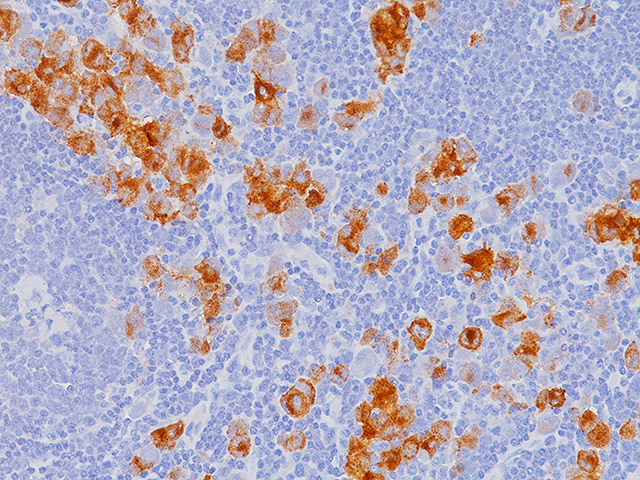
(L) - Lung ADC stained with TTF-1 + p40 (cRM) / (R) - Lung SqCC stained with TTF-1 + p40 (cRM)

TTF-1 + p40 (cRM)

Thyroid transcription factor-1 (TTF-1) is a member of the NKX2 family of homeodomain transcription factors. Studies have shown that TTF-1 is expressed in epithelial cells of the thyroid gland and lung. TTF-1 has been shown to be a sensitive (62-80%) and specific marker (89-95%) in the majority of primary lung adenocarcinomas (ADC) (1-7). When combined […]
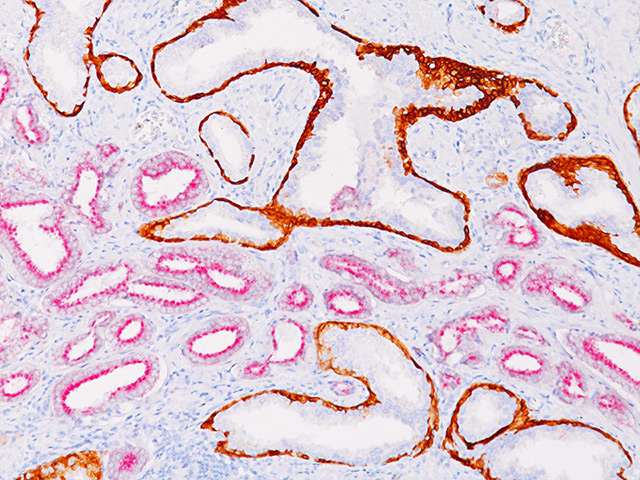
CK HMW + p63 + AMACR (RM)

High molecular weight cytokeratins are expressed in a variety of normal and neoplastic epithelial tissues.15 p63, a homolog of the tumor suppressor p53, has been identified in proliferating basal cells in the epithelial layers of a variety of tissues, including epidermis, cervix, urothelium and prostate.16 αMethylacyl coenzyme A racemase (AMACR), also known as P504S, is […]

CDX2 (M) + CDH17 (RM)

CDX2 is a homeobox gene that encodes an intestine-specific transcription factor (1). CDX2 has been useful to establish gastrointestinal origin of metastatic adenocarcinomas and carcinoids and can be especially useful in distinguishing metastatic colorectal adenocarcinoma from tumors of unknown origin (1-7). CDX2 has been shown to be more specific and more sensitive than villin or […]

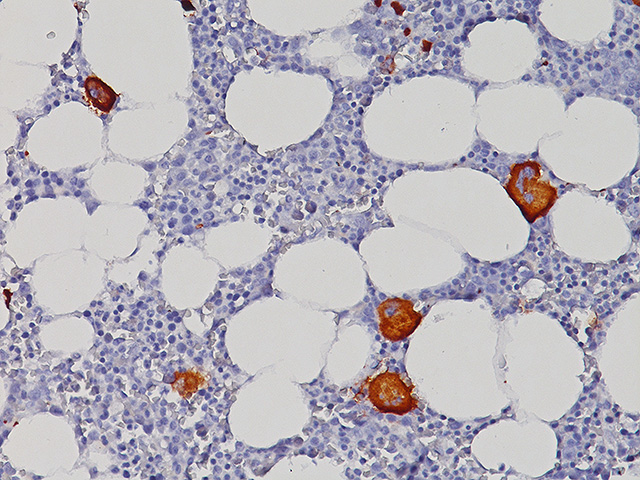
Megakaryocyte in bone marrow stained with CD11c (Leu-M5) antibody

CD11c (Leu-M5)

CD11c (also known as Leu-M5 or Integrin alpha X) [5D11] is a member of the leukointegrin family. CD11c is a cell surface adhesion receptor and is predominantly expressed in tissue macrophages, dendritic cells, monocytes, NK cells and granulocytes. CD11c has been shown to be both sensitive and specific for hairy cell leukemia (HCL) (1). CD11c […]

Melan A (M)

Melan-A (MART-1) [A103], a melanoma-specific antigen, is a transmembrane protein and a melanocyte differentiation marker recognized by cytotoxic T lymphocytes. Melan-A is expressed in skin, in the majority of melanocytes and in renal angiomyolipomas.15-17

IgG4 (M)

The Biocare IgG4 [HP6025] antibody detects human IgG4, a subclass of immunoglobulin G, and specifically recognizes the Fc region. Mouse monoclonal IgG4 [HP6025] is highly specific and may be useful in the diagnosis of IgG4-related systemic disease (IgG4-RSD), also known as IgG4-related sclerosing disease, which can affect multiple organs and is characterized by lymphoplasmacytic infiltration, […]

MDM2 (12q15) Red + Copy Control 12 Green FISH Probe

The MDM2 gene is located in the chromosomal region 12q15 and encodes for an E3 ubiquitin ligase which acts as a major negative regulator of the tumor suppressor p531. Due to amplification of the respective chromosomal region, MDM2 is overexpressed in many human tumors such as soft tissue sarcomas, osteosarcomas2, gliomas, NSCLC, gastric and breast […]

Mantle cell lymphoma stained with SOX11 (M) antibody

SOX11 (M)

The SOX11 (M) [SOX11-C1] antibody is a mouse monoclonal antibody developed for the detection of SOX11 (SRY-box transcription factor 11), a member of the SOX family of transcription factors involved in embryonic development and cellular differentiation.15 SOX11 is strongly expressed in most cases of mantle cell lymphoma (MCL), including those that are cyclin D1-negative, making […]

Prostate cancer stained with CK HMW + p63

CK HMW + p63, 2X

High molecular weight cytokeratins are expressed in a variety of normal and neoplastic epithelial tissues (1). In prostate, CK HMW [34βE12] has been shown to be a useful marker of basal cells of normal glands and prostatic intraepithelial neoplasia (PIN), a precursor lesion to prostatic adenocarcinoma; whereas invasive prostatic adenocarcinoma typically lacks a basal cell […]

Prostate cancer stained with CK HMW + p63 + AMACR (RM)

CK HMW + p63 + AMACR (RM) (ONCORE)

High molecular weight cytokeratins are expressed in a variety of normal and neoplastic epithelial tissues (1). In prostate, CK HMW [34βE12] has been shown to be a useful marker of basal cells of normal glands and prostatic intraepithelial neoplasia (PIN), a precursor lesion to prostatic adenocarcinoma; whereas invasive prostatic adenocarcinoma typically lacks a basal cell […]

Email Cart