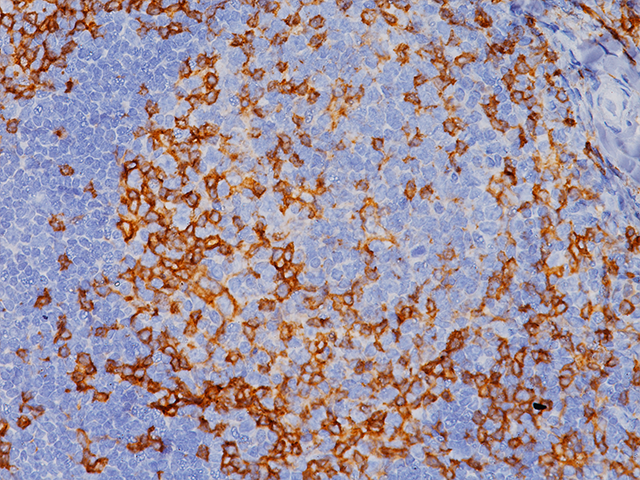
CD4 is a transmembrane glycoprotein, expressed on normal thymocytes, T-helper cells, the majority of mature peripheral T cells, and a subset of suppressor or cytotoxic T cells (1). Like many cell surface receptors/markers, CD4 is a member of the immunoglobulin superfamily. CD4 is expressed in the majority of T-cell lymphomas, including mycosis fungoides (2). CD4 […]
Terminal Deoxynucleotidyl Transferase antibody (TdT) is a nuclear protein widely used as a marker for lymphoblastic leukemia. TdT is a template-independent DNA polymerase which has been shown to be responsible for the addition of nucleotides at the N-region junction of rearranged Ig heavy chain and T-cell receptor gene segments during the maturation of B- and […]
Protein Gene Product 9.5 (PGP9.5) is also known as ubiquitin C-terminal hydrolase 1 (UCHL-1). Expression of PGP9.5 is highly specific to neurons and to cells of the diffuse neuroendocrine system and their tumors. It is estimated that PGP9.5 antibody comprises 1-2% of total soluble proteins in the brain. Immunohistochemistry of routinely processed neuronal tissues has […]
GATA-3 (GATA binding protein 3) is a member of the GATA family of transcription factors. This 50 kDa nuclear protein regulates the development and is expressed in specific cell types within a variety of tissues.1,2 GATA-3 is a zinc finger transcription factor and plays an important role in promoting and directing cell proliferation, development, and […]
This is a monoclonal antibody to the A-subunit of human coagulation Factor XIII. Studies have shown it recognizes human Factor XIII Achain in both reduced and non-reduced forms. It does not react with human Factor XIII B-chain or human Factor XII. Factor XIII is a betaglobulin found in plasma and is composed of two subunits. […]
The Biocare Epithelial Membrane Antigen (EMA) antibody recognizes a heterogeneous family of highly glycosylated transmembrane proteins known as human milk fat globule (HMFG) membrane proteins. Although originally identified in breast tissue, EMA expression is also found in secretory epithelial cells, to a lesser degree in non-secretory epithelium (e.g., squamous epithelium), and rarely in non-epithelial cells.15,18 […]


![Breast cancer stained with Epithelial Membrane Antigen (EMA) [E29]](https://biocare.net/wp-content/uploads/3038.jpg)