Gross cystic disease fluid is a pathologic secretion from breast composed of several glycoproteins, including GCDFP-15. It is considered to be a marker of apocrine differentiation.15,16 Numerous studies have shown GCDFP-15 (BRST2) to be a specific marker for breast cancer in formalin-fixed paraffinembedded tissues.15,17,18 Other types of tissues that express GCDFP-15 are axillary sweat glands […]
This antibody reacts with human Glial Fibrillary Acidic Protein antibody and does not react with other intermediate filaments. Anti-GFAP stains astrocytes, ependymal cells and corresponding tumors. In the peripheral nervous system, GFAP stains Schwann cells, enteric glial cells and satellite cells. Weak staining of axons has been observed which is caused by cross-reaction with neurofilament. […]
In human prostate cancer, the ERG oncogene is frequently overexpressed due to chromosomal translocations involving ERG and regulatory sequences of the TMPRSS2 or other androgen responsive genes. In particular, the TMPRSS2:ERG fusion gene has been found to be the most frequent gene rearrangement in prostate cancers, occurring in 45-65% of North American patients. A mouse […]
This antibody reacts with human Alpha-1-Fetoprotein (AFP). Alpha-1-Fetoprotein antibody reacts with germ-cell tumors, gonadal tumors and liver carcinoma. Neoplasms commonly associated with Alpha-1-Fetoprotein (AFP) production are hepatocellular carcinomas and some germ cell tumors, typically yolk sac tumor. Rare tumors of visceral origin may also be associated with Alpha-1-Fetoprotein (AFP) production. Studies show that in hepatocellular […]
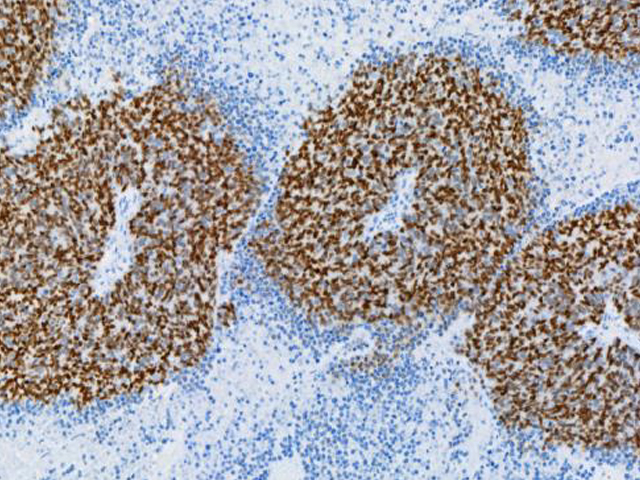
Protein gene product 9.5 (PGP 9.5), also known as ubiquitin carboxyl-terminal hydrolase-1 (UCH-L1), is a 27-kDa protein originally isolated from whole brain extracts.15 The protein is highly conserved and localized in neurons and neuroendocrine cells, forming an estimated 5-10% of cytoplasmic protein.16 The detection of fine nerves in peripheral tissues using PGP 9.5 antibodies is […]
Transducin-like enhancer of split 1 (TLE1) is a member of the TLE family of transcriptional co-repressors that control the transcription of a wide range of genes and has been implicated in embryogenesis, hematopoiesis, and neuronal and terminal epithelial differentiation.15 TLE1 is involved in the Wnt/β-catenin signaling pathway, which is important in synovial sarcomas, and in […]
Insulinoma-associated protein 1 (INSM1), a zinc-finger transcription factor, is a key regulator of neuroendocrine differentiation during development, and has recently emerged as a reliable immunostaining marker with a nuclear staining pattern for the identification of neuroendocrine and neuroepithelial neoplasms.15,16 Several studies have demonstrated nuclear INSM1 expression in multiple neuroendocrine tumor types, including small cell carcinomas […]
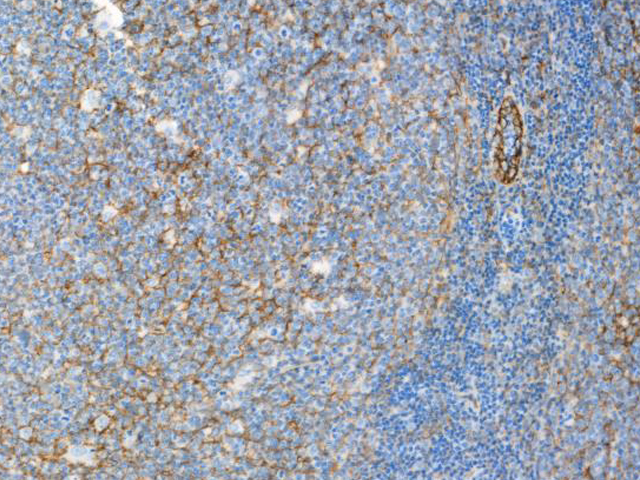
CD54, also known as Intercellular adhesion molecule 1 (ICAM1) is a 90 kDa glycosylated transmembrane protein of the immunoglobulin superfamily. CD54 plays an important role in immunological synapse formation, T-cell activation, leukocyte migration, and numerous cellular immune responses.15 While some studies have shown that CD54 promotes tumor metastasis by regulating various signaling pathways in some […]


![Pancreatic neuroendocrine tumor stained with PGP9.5 [UCHL1/4556R] antibody.](https://biocare.net/wp-content/uploads/3305.jpg)


![Tonsil stained with CD54 [E3Q9N] antibody.](https://biocare.net/wp-content/uploads/3296.jpg)