Dermatofibroma stained with Factor XIIIa Antibody

Factor XIIIa

This is a monoclonal antibody to the A-subunit of human coagulation Factor XIII. Studies have shown it recognizes human Factor XIII Achain in both reduced and non-reduced forms. It does not react with human Factor XIII B-chain or human Factor XII. Factor XIII is a betaglobulin found in plasma and is composed of two subunits. […]

Blood vessels in lung stained with Factor VIII antibody

Factor VIII

Factor VIII is a rabbit polyclonal antibody that is intended for laboratory use in the qualitative identification of von Willebrand factor protein by immunohistochemistry (IHC) in formalin-fixed paraffin-embedded (FFPE) human tissues. The clinical interpretation of any staining or its absence should be complemented by morphological studies using proper controls and should be evaluated within the […]

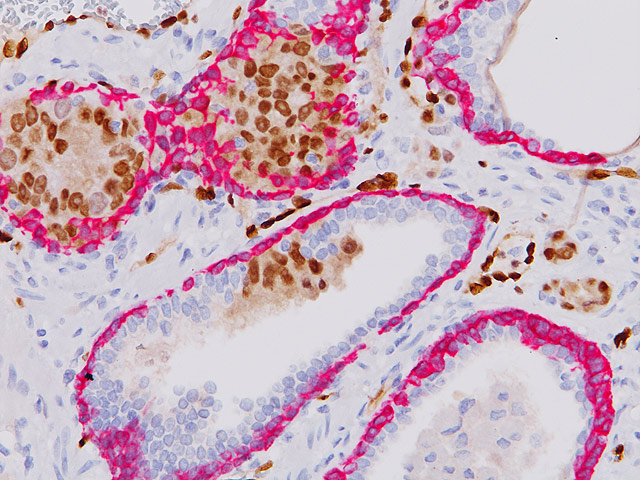
ERG (DAB) + CK5 (FR) in prostate cancer and PIN

ERG-2 (ERG + CK5)

Chromosomal translocations involving the ETS transcription factors, such as ERG and ETV1, are frequent events in human prostate cancer pathogenesis. In particular, the TMPRSS2-ERG fusion gene has recently been found to be the most frequent gene rearrangement in prostate cancers, occurring in 45-65% of North American patients. Recent reports have demonstrated a strong correlation between […]

Prostate cancer stained with ERG + AMACR antibody

ERG + AMACR

In human prostate cancer, the ERG oncogene is frequently overexpressed due to chromosomal translocations involving ERG and regulatory sequences of the TMPRSS2 or other androgen responsive genes. Recently, a mouse monoclonal anti-ERG antibody was developed with an unprecedented 99.9% specificity for detecting prostatic adenocarcinoma. The report shows strong correlation between the expression of the ERG […]

ERG translocation in prostate cancer

ERG (M), 2X

In human prostate cancer, the ERG oncogene is frequently overexpressed due to chromosomal translocations involving ERG and regulatory sequences of the TMPRSS2 or other androgen responsive genes. In particular, the TMPRSS2:ERG fusion gene has been found to be the most frequent gene rearrangement in prostate cancers, occurring in 45-65% of North American patients. A mouse […]

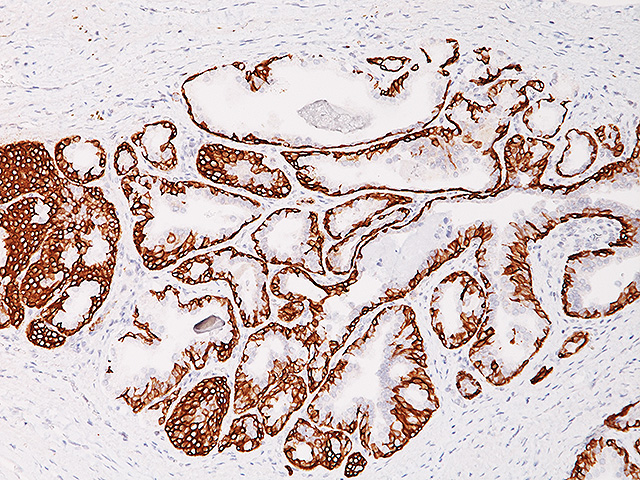
Prostate cancer stained with ERG antibody

ERG

In human prostate cancer, the ERG oncogene is frequently overexpressed due to chromosomal translocations involving ERG and regulatory sequences of the TMPRSS2 or other androgen responsive genes. In particular, the TMPRSS2:ERG fusion gene has recently been found to be the most frequent gene rearrangement in prostate cancers, occurring in 45- 65% of North American patients. […]

Colon cancer stained with D2-40 + CD31

D2-40 + CD31

D2-40 is a selective marker of lymphatic endothelium in normal tissues and vascular lesions. According to studies, D2-40 effectively marked the lymphatic channel endothelium, but not the adjacent capillary. CD31, also known as PECAM-1, is a 130 kDa integral membrane glycoprotein found on the surface of endothelial cells, platelets and some hematopoietic cells. The CD31 […]

Lung squamous cell carcinoma stained with Cytokeratin 17 antibody (CK17)

Cytokeratin 17 – CK17

CK17 antibody reacts with a 40kDa polypeptide and CK17 is a type I keratin. Studies have shown that it is indicated as an excellent marker for the identification of squamous cell carcinomas in various tissues including the cervix, lung, and oral cavity.18 CK17 may be helpful to aid in distinguishing myoepithelial cells from luminal epithelium […]

Prostate stained with Cytokeratin 5/14

Cytokeratin 5/14, 2X

Cytokeratin 5/14 Cocktail, 2X is being discontinued. We will continue to offer these products until 06/30/16 or until current inventory is depleted, whichever occurs first. Biocare does offer Cytokeratin 5/14 Cocktail, catalog numbers ACI3025 & API3025 as a substitute. CK5 [XM26] has been shown to have positive reactivity for CK5 protein and lack of reactivity […]

Prostate stained with Cytokeratin 5/14 antibody

Cytokeratin 5/14 Cocktail

CK5 is distributed in many non-keratinizing stratified squamous epithelia such as tongue mucosa, basal epithelia, hair follicles, trachea, as well as basal cells in prostate glands and myoepithelial cells in mammary glands.15-19 CK5 is also expressed in most epithelial and biphasic mesotheliomas. CK5 has also been noted in large cell carcinomas and pulmonary squamous cell […]

Email Cart